‘The Re-Creation Story’.
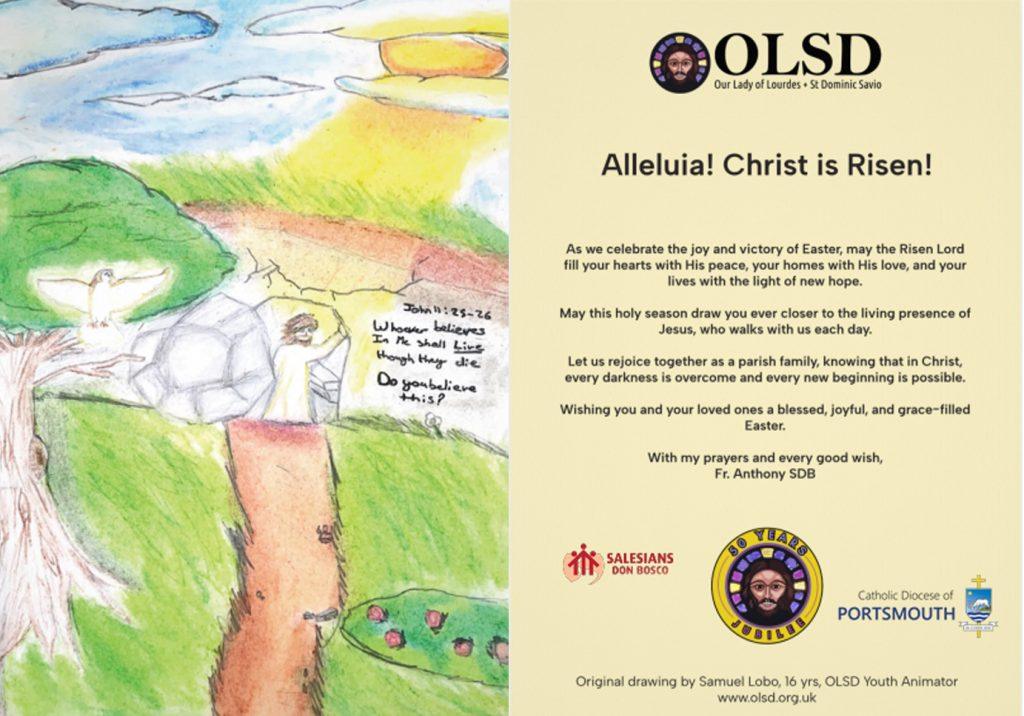
This Easter, in our Jubilee Year, a year in which we are consciously seeking to empower and give voice to the young people of our parish, I found myself deeply moved and inspired by something beautifully simple: an Easter card.
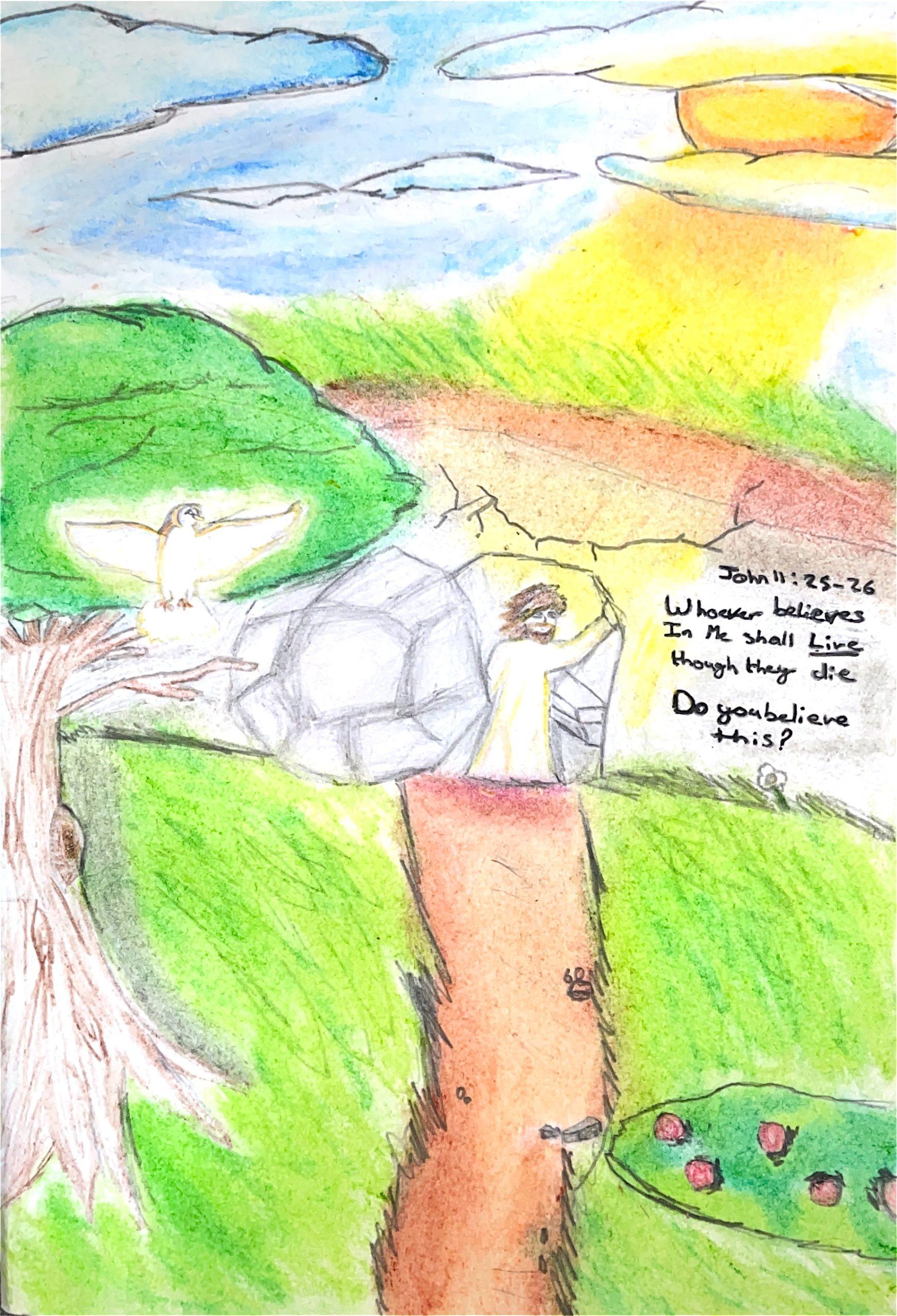
Drawn by one of our own youngsters, 16-year-old, Samuel Lobo, this image became far more than just a piece of artwork. It became, for me, a window into prayer, a companion through Holy Week, and ultimately the seed of my Easter Sunday homily on “The Re-Creation Story.”
Throughout Holy Week, I returned to this image again and again in my prayer. At first glance, it is a depiction of the Resurrection: the empty tomb, the risen Christ, the light breaking through darkness. But as I sat with it, something deeper began to emerge. This was not just resurrection, it was re-creation.
What struck me most was how the whole image echoes the story of Adam and Eve. In the beginning, creation was full of colour, harmony, and life. Sin fractured that beauty, introducing division and darkness. Yet here, in Samuel’s drawing, we see that same creation being brought back to life, greener, brighter, filled once more with light.
This became the heart of my Easter homily. The Resurrection is not simply about life after death; it is about life remade. Christ is the New Adam, and through Him, the world is not discarded but renewed. And even more beautifully, as was reflected in our congregation, we are not merely spectators of this new creation, we are part of it. In the Risen Christ, we become the New Eve, the new humanity, restored in dignity and beauty. What was once lost through sin is now renewed through grace. And so, in Him, we are able once more to be full of colour, alive with faith, hope, and love.
In this Jubilee Year, as we strive to empower our youngsters, this was a moment of grace. It was not just about encouraging them; it was about receiving from them. Through Samuel’s creativity, I witnessed the Risen Christ at work in our parish, speaking afresh, bringing new life, and reminding us that the Spirit continues to inspire hearts, young and old alike.
During the Easter Octave, I had the joy to hear more from Samuel about the inspiration behind his drawing. It was a beautiful opportunity to step into the mind of the artist, to understand not just what he drew, but why. His reflections revealed a simplicity and sincerity that made the message even more powerful: faith expressed through creativity, and creativity rooted in Christ.
This Easter card has been a gift to our parish. It has reminded me, and I hope all of us, that resurrection is not just something we celebrate once a year. It is something we are invited to live.
Christ is risen and even now, He is at work, re-creating, renewing, and bringing colour back into our world.
To watch the Easter Sunday homily, please click here: Fr Anthony’s Easter Sunday Homily 2026
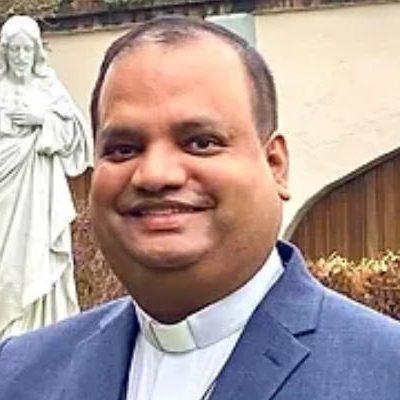
Fr Anthony interviews Samuel Anthony Lobo, 16-year-old youngster and youth animator who drew the Parish Easter Card.
1. What first inspired you to create this Easter card for the parish?
I had quite a bit of free time when the competition was announced in the parish newsletter by the youth ministry team, and instead of doing nothing, I felt inspired to take part. It seemed like a friendly competition and a good opportunity to share some of my ideas.
2. When you began, did you already have a clear image in your mind, or did it develop as you were drawing?
When I started, I didn’t overthink it. I simply began sketching, and as I continued, the ideas developed naturally. I added notes and annotations along the way before completing the final piece.
3. Why did you choose the words from John 11:25–26: “Whoever believes in me shall live…”?
I chose this passage because it speaks about both the resurrection after death but also the source of it, Jesus. I was also drawn to the question, “Do you believe this?” which Jesus asks Martha, the sister of Lazarus. I also feel like Jesus is also breaking the 4th wall, questioning us, the readers directly. We often say we believe, but we do not always stop to reflect on whether we truly live that belief, especially when we face doubts about the future.
4. What message were you hoping people in the parish would take away from your card?
If there was one thing that I would’ve liked the parish to take away from the card it is that if a card that isn’t a masterpiece and only drawn by a 16 yr old with little experience could be interpreted to have so much meaning, imagine how much meaning is within the everyday things we see around us from flowers to the many animals and to the parishioners themselves, since they are made perfect by the creator who had his masterpiece in his mind long before they were ever here. I would like the parishioners to embrace their surroundings, learning from the hidden meanings present in all that God has created.
Symbolism in the Artwork
5. Can you explain the symbolism in your drawing? Are there any hidden meanings?
The sun is shaped like an eye, with the cracks in the hill forming a smile, symbolising God the Father saying, “This is my Son, whom I love.”
The presence of the Father, Son, and Holy Spirit was very important to me. I wanted to show the Trinity, especially as revealed at Jesus’ baptism, symbolising the beginning of new life in faith. The circular design represents how God is present from birth, through life, to death and resurrection.
There is also a number 6 on the boulder covering the tomb that was rolled over. For me, 6 represents human imperfection and evil (the “mark of the beast”), while 7 represents God’s perfection and completeness. Humanity falls short of God’s standard, (7 days of creation) and symbolically, it is our sin that places Jesus in the tomb. When the stone is rolled away, it represents not only the Resurrection, but also the removal of our sins. However, as humans, we sin and so are 1 short of God’s standard. And so it is we who trap Jesus in his tomb (the stone), and as he resurrects, the stone is rolled away, and so are our sins.
The path leading to Jesus is uneven and crooked, showing that following Him is not easy. The rose bush is beautiful, but its thorns cause pain, this reflects how the Christian journey includes both struggle and beauty but ultimately leads to joy.
The tree represents both life and the Cross. Just as a tree gives life, the Cross, the “tree”, brings us new life through Christ. It also recalls the Fall of Adam and how Jesus restores what was lost: “For as death came through one man, life comes through one man.”
There is only one flower in the card. It’s not that there is no grass or places it could grow, but still, there is only 1. I drew this to symbolise Jesus’s final mission to us as Christians, to spread the word. “The harvest is plenty, but the workers are few.”
The roses also recall the crown of thorns placed on Jesus. What was once a sign of suffering is now transformed into life and beauty through the Resurrection.
Then also the roses, their dead thorns were put as a crown on the head of Jesus, our king, but now they too are no longer dead but flourish.
6. What materials did you use to create the drawing?
I used oil pastels and colouring pencils for the colouring, and a regular pencil for sketching and outlining.
7. How long did it take you from start to finish?
I didn’t complete it all in one day. I worked on it little by little over several days. Altogether, it probably took around three hours to sketch and complete both the draft and final version.
8. Which part of the drawing did you find most challenging?
Drawing Jesus was the most challenging, especially because I had to finish it close to the deadline. I also find drawing human faces and fine details quite difficult.
9. Which part did you enjoy creating the most?
I enjoyed the whole process. Each day I looked forward to adding something new as ideas came to mind.
10. Did you make any changes along the way?
Yes. My initial sketch had many elements and looked quite messy with annotations. But by the time I started the final version, I had a clear plan in mind.
Faith and Creativity
11. How does your faith influence your art?
My faith deeply influences my art and everything I do. I don’t take full credit for my work, I see it as inspired by God, who supports and guides me.
12. Did you pray or reflect on Scripture while working on this drawing?
Yes, I read the Bible several times while working on it, and that helped shape many of the ideas in the drawing.
13. Do you see art as a way of sharing your faith?
Yes. I like expressing my faith through art, but I also appreciate when others interpret it in their own way. It is how I feel we can have a closer connection with God.
Personal Reflection
14. How did you feel when your artwork was chosen and mentioned in the Easter Sunday homily?
I really liked it. I enjoy seeing how people interpret my work differently—it reveals something about them and how it influences their thinking.
15. What has this experience taught you about your gifts?
It has taught me I should practise expressing my creative side as well as my analytical and logical side, as I love stuff like maths, science, etc.
16. Would you like to create more artwork for the parish?
Yes, hopefully I would.
17. What would you say to other young people who are unsure about sharing their art?
It doesn’t matter whether you think your work is good or not. What matters is that you try. Even simple work can carry meaning and touch people in unexpected ways.
18. If you were to draw another Gospel scene, what would it be?
I would draw Jesus helping Peter walk on the water, because it shows how far faith can take you if you do not doubt. I would also draw the conversion of St Paul, because it reminds us that no one is ever too far from God. He will never leave you, only we should be willing to accept him and follow him.